

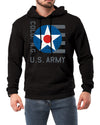
US Army Air Corps - Hoodie
£45.00
The USAAC insignia
The US Army Air Service was formed by order of President Woodrow Wilson in 1917 as the US entered the First World War after which the United States Army Air Corps was formed in 1926 as part of the United States Army as a result of legislative changes in the War Department. The service rapidly grew in the 1930s even during the Great Depression. In 1941 the Army Air Corp's role change to training and logistics within the newly formed United States Army Air Forces (USAAF). This design features a weather worn cocarde of white star and red dot.
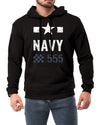
US Navy - Hoodie
£45.00
US Navy insignia
US Naval aviation began with aviator Glenn Curtiss who was contracted by the US Government to fly aircraft from land bases and from aboard ships at sea. The first of which was from the cruiser USS Birmingham by a Curtiss pilot, Eugene Ely. In World War Two the aircraft carrier became the most powerful naval weapon system, particularly in the Pacific War. This design features battle worn Stars and Stripes.
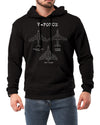
V Force - Hoodie
£48.00
V Force
V-Force is made up of the Vickers Valiant, Handley Page Victor and Avro Vulcan. These aircraft were chosen for the role of the UK's nuclear deterrent for their quick reaction capability and manouverability. The Vulcan was best known for its ability to get into the air rapidly and gain altitude at high speed. During the Cold War the RAF worked with NATO as part of a 'one-two' attack strategy. The V Bombers would destroy Warsaw Pact targets such as airbases and command centres ahead of the US SAC nuclear strikes. Most aircrews considered this ultimate sortie as a 'one-way' trip!

Valiant - Hoodie
£45.00
Vickers Valiant XD875
The Valiant started service in 1955 at RAF Gaydon. It was the first RAF aircraft to drop a nuclear bomb during a test at Maralinga, Australia. It became one of the the UK's ultimate deterrent - VForce. XD875 was the last airframe to come off the production line.
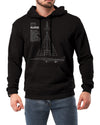
Valkyrie - Hoodie
£45.00
North American XB-70 Valkyrie
The Valkyrie was the prototype for the B-70 nuclear bomber capable of long-range sorties travelling at Mach 3 at 70,000ft. The programme for the B-70 was cancelled so the aircraft was given to research into high-speed long-duration flight with the programme finally ending in 1969. The last remaining Valkyrie is on display in the National Museum of the United States Air Force near Dayton, Ohio.
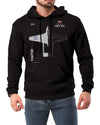
Vampire - Hoodie
£48.00
de Havilland Vampire
The Vampire first flew on 20th September 1943. The Vampire entered service just months after the end of WWII, operated by the Royal Air Force as an interceptor. The type saw service in the Suez, Malaysia and Rhodesian Bush war.
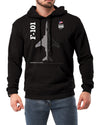
Voodoo - Hoodie
£48.00
McDonnell F-101 Voodoo
The Voodoo fighter-bomber is part of the Century Series of jets designated the F-101. It was introduced to the USAF Tactical Air Command in May 1957 as a nuclear armed fighter-bomber. The type was also in service with the Royal Canadian Air Force up until 1984. The reconnaissance version of the Voodoo was used during the Cuban Missile Crisis and was extensively used during the Vietnam War.
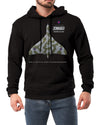
Vulcan XM607 - Hoodie
£45.00
Avro Vulcan Type-698 B2 Bomber
XM607 took part in Operation Black Buck during the Falklands conflict in 1982. As XM598 had technical problems, it was replaced by XM607, which performed the first sortie on Port Stanley Airport, piloted by Flight Lieutenant Martin Withers. XM607 undertook 3 more sorties right up until June 12.

Wellington - Hoodie
£45.00
Vickers - Armstrongs Wellington
The Wellington first flew in 1936 and entered service with the RAF in 1938 as a medium bomber and anti-submarine aircraft. Its distinctive geodetic construction, designed by Barnes Wallis, gave the bomber a greater chance of surviving anti-aircraft flak. Early in the war, Bomber Command used the Wellington for night raids before the Lancaster and Stirlings took on the role and the Wellington went on to anti-submarine duties. Just over 11,000 of these aircraft were built.
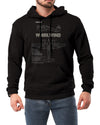
Whirlwind Fighter - Hoodie
£45.00
Westland Whirlwind
The Whirlwind entered service with the Royal Air Force as a heavy fighter in 1940. It was the most heavily armed and fastest fighters at the time and was used for ground attack missions over France, being particularly good at destroying locomotives. Due to engine and manufacturing problems the aircraft was replaced by the Hawker Typhoon in 1943.
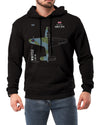
Whittle E.28/39 - Hoodie
£48.00
Gloster E28/39
The Whittle first flew on 15th May 1941. The Whittle, also known as the Pioneer or G.40 was Britain's first jet engined aircraft created for the Air Ministry to test Frank Whittle's new jet propulsion technology. This experimental aircraft led to the development of the Meteor.