
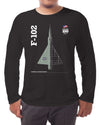
Delta Dagger - Long-sleeve T-shirt
£30.00
Convair F-102 Delta Dagger
The Delta Dagger interceptor is part of the Century Series of jets designated the F-102. It was introduced to the USAF in April 1953 and was the USAF's first operational supersonic jet. The type was used as bomber escort during the Vietnam war, but was transferred across to the Air National Guard as the Voodoo and Phantom came into service.
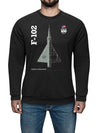
Delta Dagger - Sweat Shirt
£43.00
Convair F-102 Delta Dagger
The Delta Dagger interceptor is part of the Century Series of jets designated the F-102. It was introduced to the USAF in April 1953 and was the USAF's first operational supersonic jet. The type was used as bomber escort during the Vietnam war, but was transferred across to the Air National Guard as the Voodoo and Phantom came into service.
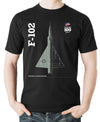
Delta Dagger - T-shirt
£27.00
Convair F-102 Delta Dagger
The Delta Dagger interceptor is part of the Century Series of jets designated the F-102. It was introduced to the USAF in April 1953 and was the USAF's first operational supersonic jet. The type was used as bomber escort during the Vietnam war, but was transferred across to the Air National Guard as the Voodoo and Phantom came into service.
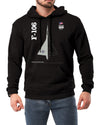
Delta Dart - Hoodie
£48.00
Convair F-106 Delta Dart
The Delta Dart is part of the Century Series of jets designated the F-106. It was introduced to the USAF in June 1959 as the ultimate interceptor. Early in its service the aircraft broke a world speed record of 1525 mph, piloted by Major Joseph W. Rogers. Its main role was as an air superiority fighter, seeing service in Alaska, Iceland, Germany and South Korea. The Delta Dart was more commonly known as the 'Six'.
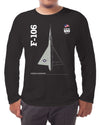
Delta Dart - Long-sleeve T-shirt
£30.00
Convair F-106 Delta Dart
The Delta Dart is part of the Century Series of jets designated the F-106. It was introduced to the USAF in June 1959 as the ultimate interceptor. Early in its service the aircraft broke a world speed record of 1525 mph, piloted by Major Joseph W. Rogers. Its main role was as an air superiority fighter, seeing service in Alaska, Iceland, Germany and South Korea. The Delta Dart was more commonly known as the 'Six'.
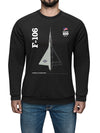
Delta Dart - Sweat Shirt
£43.00
Convair F-106 Delta Dart
The Delta Dart is part of the Century Series of jets designated the F-106. It was introduced to the USAF in June 1959 as the ultimate interceptor. Early in its service the aircraft broke a world speed record of 1525 mph, piloted by Major Joseph W. Rogers. Its main role was as an air superiority fighter, seeing service in Alaska, Iceland, Germany and South Korea. The Delta Dart was more commonly known as the 'Six'.
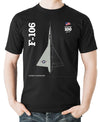
Delta Dart - T-shirt
£27.00
Convair F-106 Delta Dart
The Delta Dart is part of the Century Series of jets designated the F-106. It was introduced to the USAF in June 1959 as the ultimate interceptor. Early in its service the aircraft broke a world speed record of 1525 mph, piloted by Major Joseph W. Rogers. Its main role was as an air superiority fighter, seeing service in Alaska, Iceland, Germany and South Korea. The Delta Dart was more commonly known as the 'Six'.
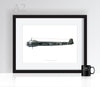
Dornier Do-17Z - Poster
from
£11.00
Please note the swastika is not displayed on the website. The print you order will have the swastika as it should appear on the tail fin.
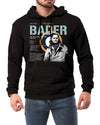
Douglas Bader - Hoodie
£45.00
Group Captain Sir Douglas Robert Steuart Bader
Bader joined the Royal Air Force in 1928 and was commissioned in 1930. In 1931 he lost both legs after crashing during aerobatics which resulted in his retirement. However, at the outbreak of war Bader was accepted as a pilot and fought over Dunkirk and throughout the Battle of Britain. This design celebrates Bader as a Fighter Ace with 22 destroyed to his name, but he was part of the RAF that was served by many men and women who were all heroes.
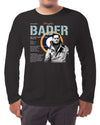
Douglas Bader - Long-sleeve T-shirt
£27.00
Group Captain Sir Douglas Robert Steuart Bader
Bader joined the Royal Air Force in 1928 and was commissioned in 1930. In 1931 he lost both legs after crashing during aerobatics which resulted in his retirement. However, at the outbreak of war Bader was accepted as a pilot and fought over Dunkirk and throughout the Battle of Britain. This design celebrates Bader as a Fighter Ace with 22 destroyed to his name, but he was part of the RAF that was served by many men and women who were all heroes.
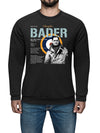
Douglas Bader - Sweat Shirt
£39.00
Group Captain Sir Douglas Robert Steuart Bader
Bader joined the Royal Air Force in 1928 and was commissioned in 1930. In 1931 he lost both legs after crashing during aerobatics which resulted in his retirement. However, at the outbreak of war Bader was accepted as a pilot and fought over Dunkirk and throughout the Battle of Britain. This design celebrates Bader as a Fighter Ace with 22 destroyed to his name, but he was part of the RAF that was served by many men and women who were all heroes.
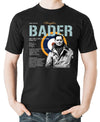
Douglas Bader - T-shirt
£24.00
Group Captain Sir Douglas Robert Steuart Bader
Bader joined the Royal Air Force in 1928 and was commissioned in 1930. In 1931 he lost both legs after crashing during aerobatics which resulted in his retirement. However, at the outbreak of war Bader was accepted as a pilot and fought over Dunkirk and throughout the Battle of Britain. This design celebrates Bader as a Fighter Ace with 22 destroyed to his name, but he was part of the RAF that was served by many men and women who were all heroes.
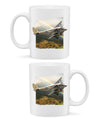
Dragon Rapide - Mug
£11.00
de Havilland DH.89A Dragon Rapide
TX310 'Nettie' from air power artist Peter Van Stigt. Peter is a commercial digital artist who is an aviation fanatic, producing aviation artwork sold around the world. The graphic features deliberate torn edges.
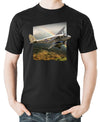
Dragon Rapide - T-shirt
£24.00
de Havilland DH.89A Dragon Rapide
TX310 'Nettie' from air power artist Peter Van Stigt. Peter is a commercial digital artist who is an aviation fanatic, producing aviation artwork sold around the world.
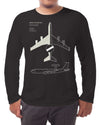
E-3D Sentry - Long-sleeve T-shirt
£27.00
Boeing E-3D Sentry
On the cancellation of the Nimrod AEW3 project, the UK and France ordered E-3 aircraft, with the E-3D to be used by the RAF. The E-3D became part of NATO Airborne Early Warning and Control Force (NAEWCF) receiving tasks directly from NATO, but also operated over Afghanistan and Iraq. The RAF Sentry was supposed to end operations in 2021, however 2 aircraft have been involved in patrols over Poland during Russia's incursions into Ukraine in early 2022.
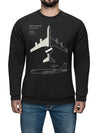
E-3D Sentry - Sweat Shirt
£39.00
Boeing E-3D Sentry
On the cancellation of the Nimrod AEW3 project, the UK and France ordered E-3 aircraft, with the E-3D to be used by the RAF. The E-3D became part of NATO Airborne Early Warning and Control Force (NAEWCF) receiving tasks directly from NATO, but also operated over Afghanistan and Iraq. The RAF Sentry was supposed to end operations in 2021, however 2 aircraft have been involved in patrols over Poland during Russia's incursions into Ukraine in early 2022.
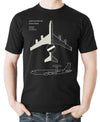
E-3D Sentry - T-shirt
£24.00
Boeing E-3D Sentry
On the cancellation of the Nimrod AEW3 project, the UK and France ordered E-3 aircraft, with the E-3D to be used by the RAF. The E-3D became part of NATO Airborne Early Warning and Control Force (NAEWCF) receiving tasks directly from NATO, but also operated over Afghanistan and Iraq. The RAF Sentry was supposed to end operations in 2021, however 2 aircraft have been involved in patrols over Poland during Russia's incursions into Ukraine in early 2022.

Eighth Air Force - T-shirt
£24.00
The Eighth Air Force was established as the VIII Bomber Command, at Langley Field, 1942. This design has been given a deliberate aged and 'weathered' appearance.